
The Short Answer: How to Read Food Labels in India
To read food labels in India, start with the nutrition table and check whether figures are given per 100 g/100 ml or per serving. Then convert the numbers to the amount you will actually eat. Look at added sugars separately from total sugars. Turn sodium into salt by multiplying by 2.5. Read the ingredient list from the top, because ingredients appear in descending order of weight. Finally, check allergens, the veg/non-veg symbol and the expiry or use-by date.
This guide explains what the Food Safety and Standards Authority of India (FSSAI) currently requires on packaged foods. It also walks through simple arithmetic so you can compare products in the supermarket aisle in under a minute. It is educational only and is not a substitute for personalised advice from a doctor or registered dietitian.
What FSSAI Currently Requires on a Packaged Food Label
Labelling of pre-packaged food in India is governed by the Food Safety and Standards (Labelling and Display) Regulations, 2020, published by FSSAI. These rules replaced the older packaging and labelling provisions. The table below summarises the label elements most useful for everyday shoppers. Exemptions exist for some small packs and certain categories, so not every product will show every line.
Serving Sizes vs Per 100 g: Do the Maths First
The single most common labelling mistake is reading the “per 100 g” column and assuming that is what you ate. Companies choose their own serving size, and it is often smaller than a realistic portion. The per 100 g column is best for comparing two products. The per-serve column, once adjusted to your real portion, is best for judging what you actually consumed.
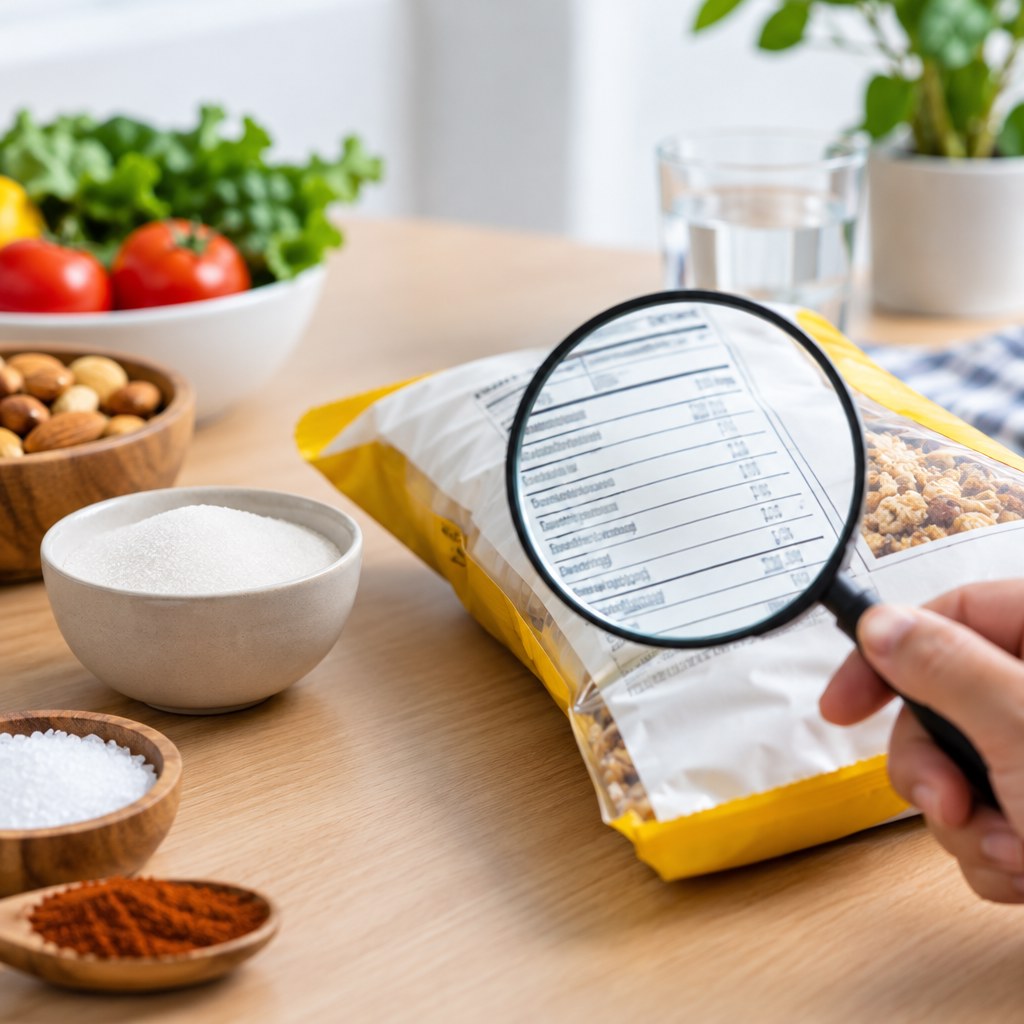
Worked example: a 150 g pack of namkeen
Imagine the label shows, per 100 g: 540 kcal and 700 mg sodium. The stated serving size is 30 g.
- Per serving (30 g): 540 × 0.3 = 162 kcal; 700 × 0.3 = 210 mg sodium.
- Whole pack (150 g): 540 × 1.5 = 810 kcal; 700 × 1.5 = 1,050 mg sodium.
The front of the pack might suggest a light snack, but finishing the whole thing during a cricket match is five servings. That one pack supplies roughly half of the WHO’s recommended upper limit of 2,000 mg sodium per day for adults.
Edge cases to watch
- “As sold” vs “as prepared”: Instant noodles, soup mixes and health-drink powders may list values for the dry product. Adding milk or the tastemaker sachet changes the totals.
- Single-consumption packs: Small packs may show values for the whole pack instead of per 100 g. Check which unit you are reading.
- Liquids: Beverages use per 100 ml. A 250 ml bottle is 2.5 times the listed figure.
Sugar on Indian Labels: Total Sugars vs Added Sugars
Under the 2020 regulations, labels show both total sugars and added sugars. They mean different things:
- Total sugars include sugars naturally present, such as lactose in milk or fructose in fruit, plus any sugar added during manufacturing.
- Added sugars are those put in during processing, such as sugar, jaggery, honey, glucose syrup and similar sweeteners.
Worked example: flavoured yogurt
A 100 g cup lists 13 g total sugars and 8 g added sugars. Roughly 5 g comes from the milk itself. The 8 g of added sugar is the part to focus on when you are cutting down. Plain curd would show only the naturally occurring portion.
Turning grams into teaspoons and calories
Sugar provides about 4 kcal per gram, and one level teaspoon of table sugar weighs roughly 4 g. A 200 ml packaged fruit drink listing 12 g sugar per 100 ml contains 24 g in total. That is about 6 teaspoons and roughly 96 kcal from sugar alone.
The WHO healthy diet guidance recommends keeping free sugars below 10% of total energy intake, with further benefits below 5%. On a 2,000 kcal diet, 10% is 200 kcal, which is about 50 g. So one drink of this kind uses nearly half that limit. If sweet cravings make this difficult, our guide on how to manage sugar cravings offers practical strategies.
Sodium vs Salt: Converting the Number That Matters
Indian nutrition tables list sodium in milligrams, while most dietary advice talks about salt in grams. Salt (sodium chloride) is about 40% sodium, so the conversion is simple:
- Salt (mg) ≈ sodium (mg) × 2.5
- Sodium (mg) ≈ salt (mg) × 0.4
Using the namkeen example: 1,050 mg sodium × 2.5 ≈ 2,625 mg, or about 2.6 g of salt in one pack. The WHO salt reduction fact sheet recommends that adults consume less than 5 g of salt (under 2,000 mg sodium) per day. That single pack therefore accounts for over half the daily limit before you count dal, sabzi, pickle or papad.
Where sodium hides
Sodium is not only in foods that taste salty. Check labels on bread, breakfast cereals, sauces, ready-to-eat curries, soup cubes, instant noodle tastemakers and even some biscuits. Ingredients such as sodium bicarbonate, monosodium glutamate (often listed as flavour enhancer INS 621) and sodium benzoate also contribute sodium, and all of it is included in the total figure.
Reading the Ingredient List Like a Pro
Ingredients appear in descending order of weight or volume at manufacture. The first two or three items make up most of the product. Consider a biscuit listing: “Refined wheat flour (maida), sugar, edible vegetable oil (palm), invert syrup, liquid glucose, milk solids, salt, raising agents…”
- Maida comes first, so a “digestive” or “multigrain” claim on the front may be less significant than it sounds.
- Sugar appears under three names: sugar, invert syrup and liquid glucose. Splitting sweeteners can push each one lower in the list, even though together they may be a major ingredient.
- Other sugar names to recognise include jaggery, honey, maltodextrin, dextrose, fructose, malt extract and fruit juice concentrate.
If a product claims “made with whole wheat” or “with real fruit”, check where that ingredient sits in the list. Some labels give its percentage, which helps you judge the claim.
Allergens, the Veg/Non-Veg Symbol and Date Markings
Allergens
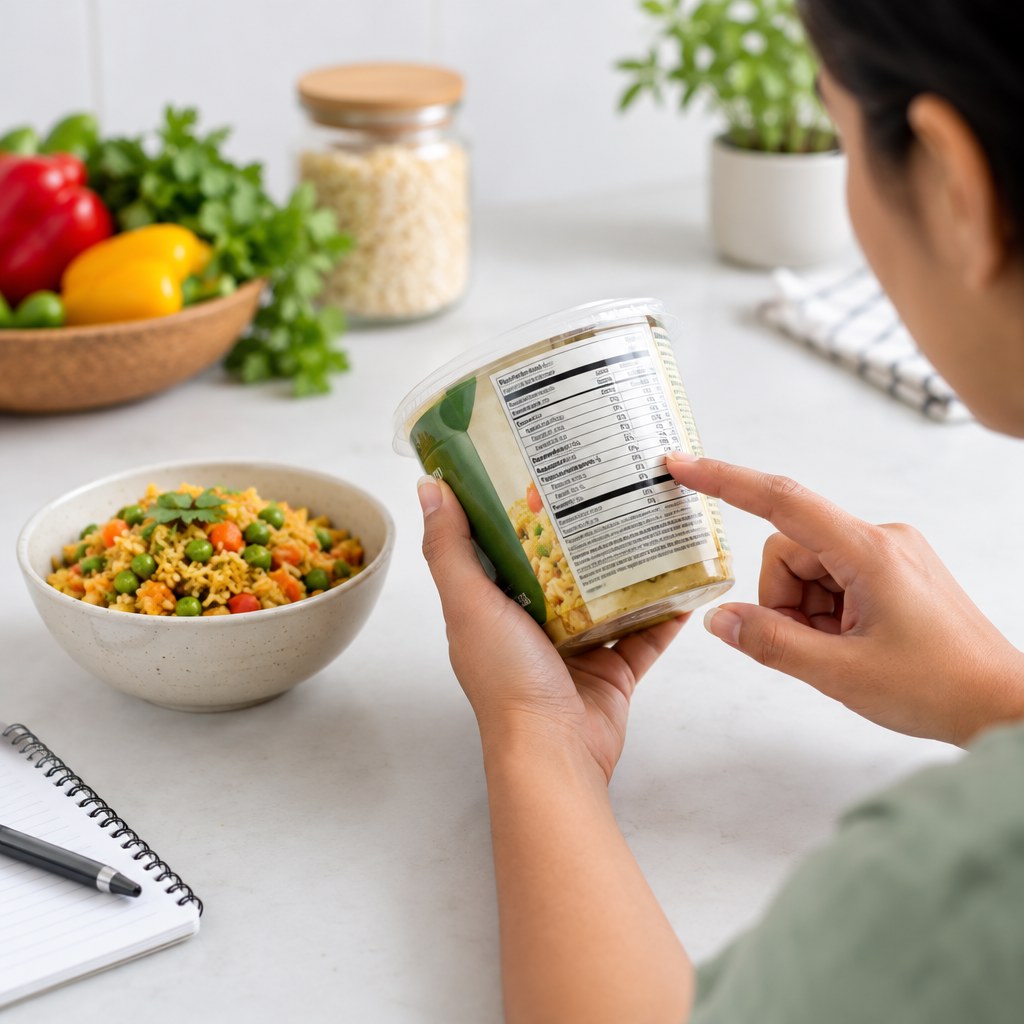
Look for a separate “Contains” statement or bolded allergens in the ingredient list. Also check precautionary lines such as “may contain traces of nuts” or “processed in a facility that also handles milk”. If you or a family member has a diagnosed allergy, read the label every time, because recipes change. Follow your clinician’s advice on precautionary statements.
Veg and non-veg symbol
The green dot means vegetarian and the brown triangle means non-vegetarian. Egg-containing products carry the non-veg mark. The symbol does not indicate whether a product is vegan, so dairy or honey may still be present.
Date markings
- Expiry / Use by: The date after which the food should not be consumed. Treat it as a safety limit.
- Best before: Indicates quality, such as crispness or flavour, rather than safety. It is meaningful only when storage instructions are followed.
- Date of manufacture/packing: Useful for judging freshness in products like oils, spices and atta.
Once you open a pack, the printed date may no longer apply. Follow instructions such as “consume within 3 days of opening” or “refrigerate after opening”.
Current Rules vs Proposals: Front-of-Pack Labelling
You may have read about front-of-pack warnings or star ratings for Indian foods. It helps to separate what is in force from what is under discussion:
- In force: The nutrition table, ingredient list, allergen, veg/non-veg and date marking requirements of the Labelling and Display Regulations, 2020, subject to their specific exemptions.
- Proposed or under discussion: FSSAI has released drafts on front-of-pack nutrition labelling, including an “Indian Nutrition Rating” star-based system. It has also considered highlighting total sugar, salt and saturated fat in bold, larger font. Treat these as proposals until a final notification appears on the official FSSAI website.
Until then, the back-of-pack nutrition table remains your most reliable tool.
Your 60-Second Label Checklist
Scale the serving
Compare the stated serving with your real portion and multiply accordingly.
Check added sugars
Divide grams by 4 to estimate teaspoons. Compare against the WHO free-sugar guidance.
Convert sodium
Multiply sodium by 2.5 for salt. Keep the 5 g daily salt limit in mind.
Scan ingredients and dates
Note the first three ingredients, hidden sugar names, allergens and the use-by date.
Frequently Asked Questions
Is a product with a “low fat” claim automatically healthier?
Not necessarily. Some reduced-fat products contain more sugar or starch to maintain taste. Compare energy, added sugars and sodium per 100 g with a regular version before deciding.
Why do two similar products show different serving sizes?
Manufacturers set their own serving sizes, so one brand may use 25 g and another 40 g. Always compare products using the per 100 g column, which is standardised.
Does “sugar-free” mean a food suits people with diabetes?
“Sugar-free” refers to sugars, not carbohydrates or calories. These products may still contain maida, maltodextrin or fats. People managing diabetes should follow guidance from their doctor or dietitian.
Summary and Next Step
Learning how to read food labels in India comes down to a few habits:
- Compare products per 100 g.
- Scale the numbers to your real serving.
- Track added sugars, not just total sugars.
- Convert sodium to salt.
- Read the ingredient list from the top.
- Never skip allergens or dates.
Packaged foods are only one part of your plate. Pair label reading with home-cooked meals built around whole grains, pulses, vegetables and fruit.


